
This Orlando estate homeowner wanted to take a serious chunk of their cooling and pool-pump bill off the grid — and they wanted the system to look as deliberate as the rest of the house. Our solar team designed a whole-home solar array spread across the home’s multi-plane tile roof, using all-black monocrystalline modules that read as architectural rather than industrial. The result is a substantial production array that captures sun from morning to late afternoon and complements the home’s Mediterranean lines instead of fighting them.
The Install
This project required equal parts solar engineering and tile-roof craftsmanship. The completed install includes:
- Expansive all-black monocrystalline array distributed across multiple roof planes
- Multi-plane production design — panels positioned on south, east, and west-facing slopes for sustained kilowatt-hour generation across the day, not just at solar noon
- Tile-specific mounting hardware that lifts every panel above the tile surface — no broken tiles, no compromised waterproofing
- Flashed roof penetrations sealed at the underlayment level, not the tile-to-tile joint
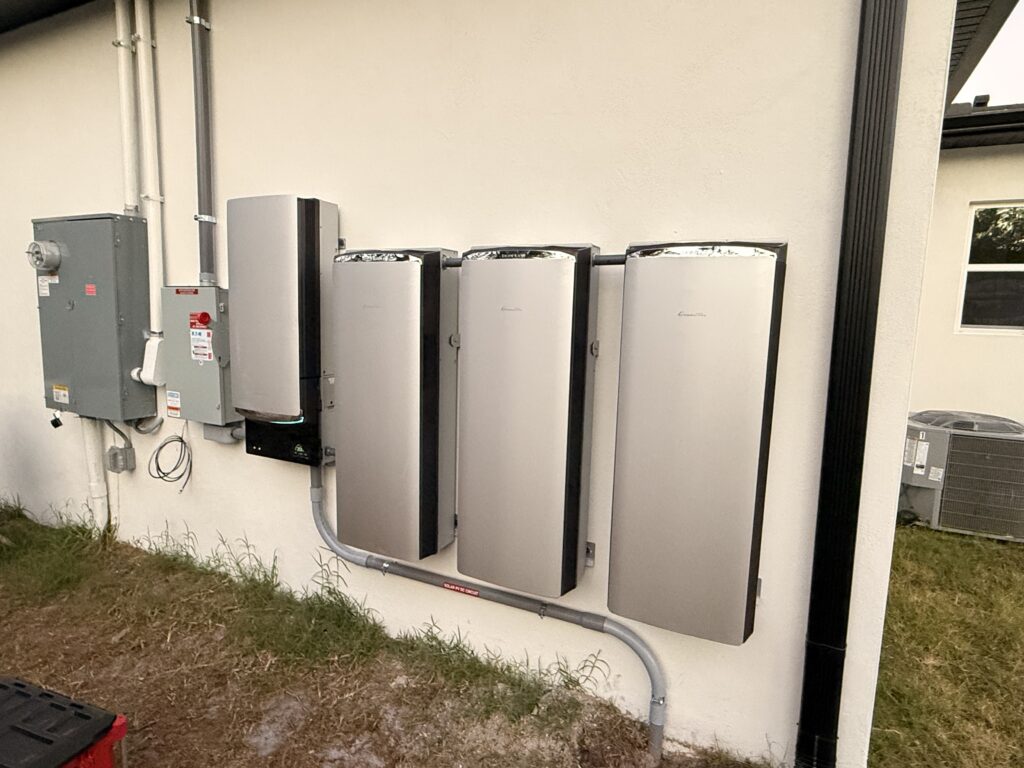
- Production-monitored inverter system with panel-level visibility, viewable from the homeowner’s phone
- Concealed conduit runs routed inside the attic wherever possible to keep the home’s exterior clean
- DC disconnect and rapid-shutdown system installed per NEC for first-responder safety
- Net-metered through Duke Energy with permission to operate (PTO) secured before the install crew left the property
Why Multi-Plane on a Tile Roof
On a Mediterranean estate like this one, the roof has hips, valleys, and dormers facing every direction. Some surfaces are perfect south-facing real estate; others get strong morning or afternoon sun. By spreading the array across all the productive surfaces — instead of cramming it all onto one face — the system produces more total kilowatt-hours per day and keeps generating across more hours, not just at peak noon. That smoother production curve matters in Florida, where utility peak rates often run into the early evening, well past the high-sun window.
Tile-Roof Specifics
Installing solar on tile is fundamentally different from installing on shingle, and getting it wrong means broken tiles, leaks, or both — sometimes years later. Our crews are trained on the specifics:
- Tile-lift technique that preserves and re-sets each tile around the mount points
- Flashing-style mount kits engineered for the home’s specific tile profile (S-tile, flat tile, or barrel tile)
- Penetration sealing that does its work at the underlayment, not at the tile joint
- Walking-lane protection during the install so adjacent tiles aren’t stressed by foot traffic
When the array is eventually removed or modified down the road, the roof underneath looks exactly the same as the day it was installed — no patchwork, no leaks the homeowner has to chase.
Built for Florida’s Climate
Every Orlando solar install our team handles gets these climate-specific details:
- Wind-rated mounting per Florida Building Code (typically 160+ mph for our region) with engineered uplift calculations on the manufacturer’s mount system
- Aluminum and stainless-steel hardware throughout — no corrosion in our humid climate
- All-black panels chosen for both aesthetics and reduced thermal expansion stress on the tile roof
- Production-monitoring with real-time alerts so an underperforming panel is flagged before the homeowner spots the dip on their utility bill
- All permits pulled and inspections coordinated with the local AHJ from start to PTO
Net Metering & ROI
Net metering with Duke Energy means every kilowatt-hour this array exports to the grid offsets a kilowatt-hour the homeowner consumes at retail rate. Florida’s net-metering rules let surplus credits roll forward month-to-month and cash out at year-end at the avoided-cost rate. For a system this size, the homeowner sees the impact on their first full billing cycle and breaks even on the install in the typical 6 to 9-year window — after which the panels keep producing for the remaining 15 to 20+ years of their warrantied life. That’s a long stretch of essentially free electricity.
Bob Heinmiller — Licensed in Central Florida Since 1981
Bob Heinmiller has been a licensed Central Florida contractor since 1981. When you’re looking at a solar project in this gallery, you’re seeing the work of an electrical and HVAC team that understands how solar integrates with the rest of the home — the main service panel, the AC system, and any standby generator or EV charger. That cross-trade fluency is something a solar-only installer can’t replicate.
The Result
A homeowner producing significant clean energy from their own roof, a tile roof preserved exactly as it was, panel-level monitoring on their phone, and a long-term hedge against Florida’s rising electric rates. The system pays itself off, then keeps paying.